

Malnutrition and Its Relationship to Constipation in Children
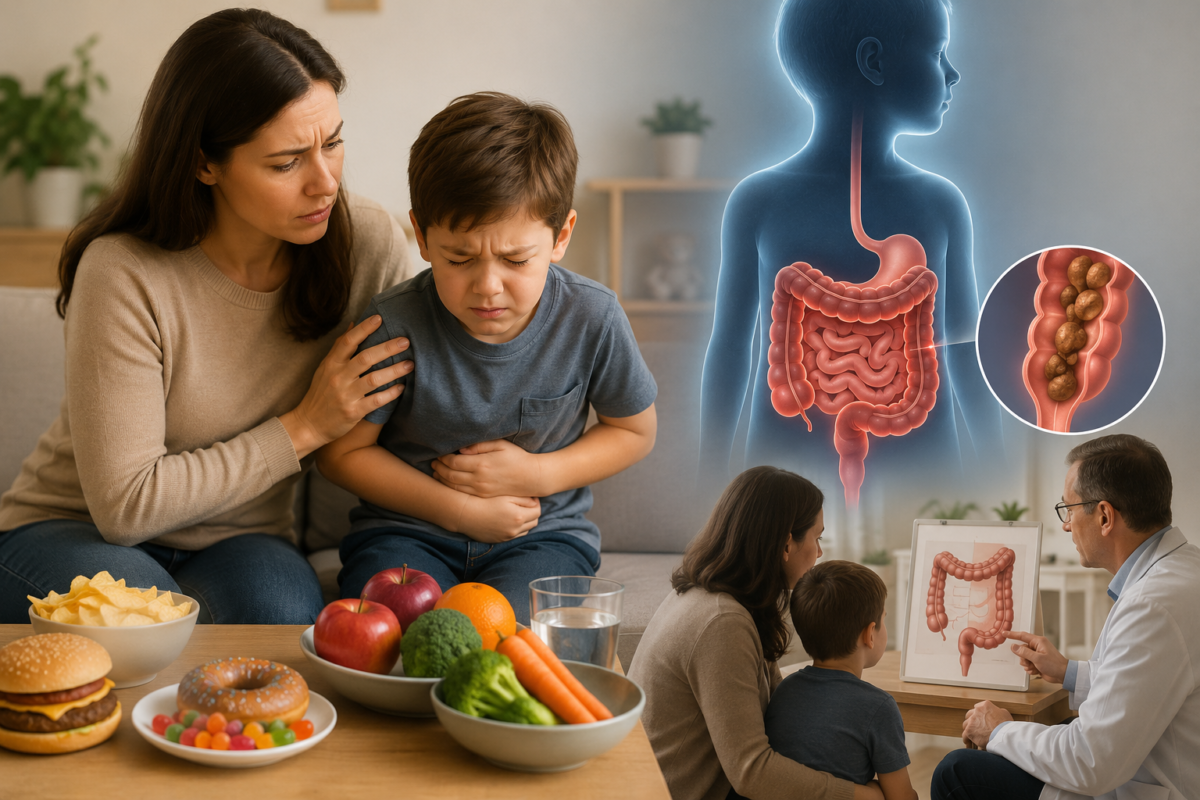
Constipation is one of the toughest challenges a mother faces with her child, not just because it’s hard to manage, but because young children often can’t put what they’re feeling into words or describe their discomfort clearly. Limiting processed foods high in sugar, starches, and fat, combined with closely monitoring a child’s habits and any early changes, goes a long way toward preventing constipation in most cases.
Types of Food and Their Relationship to Constipation in Children
Poor nutrition remains the leading cause of constipation in children. A child’s diet needs enough fiber to form a stool mass that the intestines can move efficiently through normal peristaltic action. Children naturally gravitate toward sugary, starchy foods, and these get absorbed by the digestive system at rates above 90%, leaving only a small residue to reach the colon — residue that’s genuinely difficult for the body to pass.
High-sugar, high-fat foods also encourage bacterial overgrowth in the colon, accelerating fermentation and increasing gas production. This leads to bloating and a general slowdown in colon motility. When the colon slows down, stool passage is delayed by a day, and the delayed stool becomes harder as more water is reabsorbed. By the time it builds up to the second or third day, the child needs to pass it — and by day three, the process becomes genuinely painful, particularly with the first, hardest portion of stool. Passing it can tear the mucous lining of the anal canal, causing sharp pain and sometimes minor bleeding.
When Constipation Persists Despite a Healthy Diet
Sometimes a mother insists her child eats plenty of vegetables and fruit, with minimal sweets or starches — yet the constipation persists. At this point, the issue is likely medical rather than dietary. One of the most recognized causes is a congenital defect affecting the nerve endings leading to the lower rectum: a ring of tissue just below the rectum and above the anal canal that lacks adequate nerve supply, or has none at all, leaving that segment of the rectum without normal sensation or movement.
How Does Normal Bowel Movement Work And Where Does It Go Wrong?
A normal bowel movement relies on the child sensing stool in the rectum, which triggers nerve signals to the brain prompting the urge to go, along with rectal contractions pushing the stool forward and the anal canal opening to let it pass. When sensation is absent in the affected segment, stool keeps accumulating in the rectum until it reaches a volume large enough to trigger a normal sensory signal — often not until day four or five. By then, when the child tries to go, the anal canal doesn’t open properly. This is when mothers often turn to repeated use of oral laxatives or rectal suppositories, leaving the child physically and emotionally exhausted.
.
What Happens to the Rectum as the Child Gets Older?
As the child grows older, episodes of constipation become more frequent and harder to resolve, while the rectum’s capacity to store stool keeps increasing — stretching and weakening its walls until, in some cases, it reaches a significantly enlarged size that’s difficult to restore to normal, even once the underlying cause is treated. A separate group of children doesn’t sense the buildup at all, until the stool hardens completely inside the rectum and fills it, eventually causing stool to pass involuntarily through the anal canal — not from weak control muscles, as many mothers assume, but from the sheer hardness and volume of the impacted stool. In these cases, the sphincter muscles themselves are typically perfectly intact.
Chronic Severe Constipation and Its Effect on Growth
Some children also experience severe chronic constipation, going without a bowel movement for up to seven days, and in some cases as long as two weeks. This group typically has an underlying dysfunction in the pelvic floor and anal canal muscles that disrupts normal evacuation, and over time, this affects the child’s overall growth due to both poor nutrient absorption and the ongoing inability to empty the bowels properly.
Dr. Ali Shafik for Treating Constipation in Children
If your child’s constipation persists despite dietary improvements, or if you’ve noticed any of the signs described above, it’s best not to wait. Dr. Ali Shafik, Professor of Colorectal Surgery at Cairo University’s Kasr Al Ainy Faculty of Medicine and President of the Mediterranean Society of Colon and Rectum, offers a precise evaluation of your child’s condition at Ahmed Shafik Hospital to identify the true underlying cause and the most appropriate treatment plan for childhood constipation.
All you need to do is reach out to us for your peace of mind and your child’s comfort, and to ensure proper treatment.

